
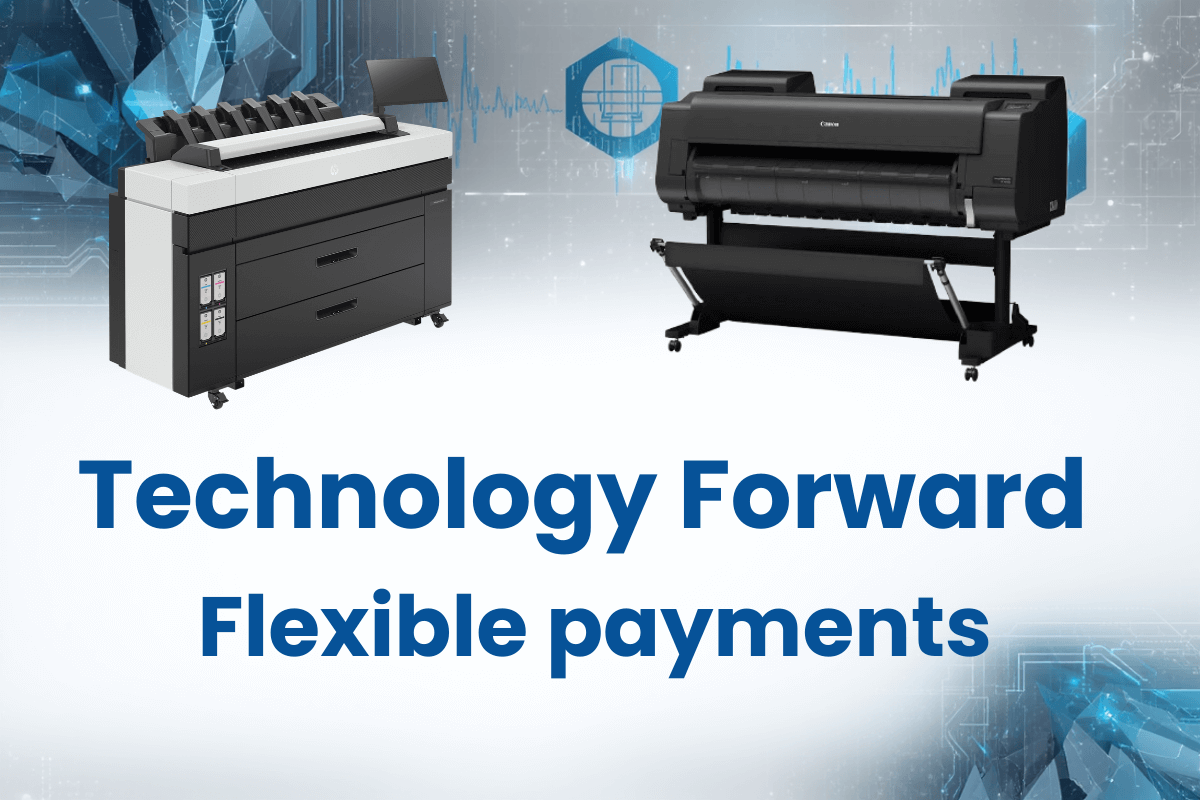
Large-Format Printer Rental vs. Lease: Which Is Better?
Key Points (TL;DR)
- One payment: A large-format printer rental combines the equipment, parts, and labor into a fixed monthly payment.
- Typical term: TAVCO term rentals usually run 24 to 48 months.
- Clean exit: At term end, you can continue, trade, buy out at 15% to 30%, or return.
- Tax tradeoff: Section 179 favors purchases and $1-buyout leases over rentals.
Introduction
Roughly 82% of U.S. businesses used some form of financing for equipment and software purchases, according to the Equipment Leasing & Finance Foundation. Financing is the default. The harder question is which structure you choose, and a large-format printer rental is the option many AEC firms never compare.
Traditional plotter leases and managed print contracts often hide their real cost in meter reads, overage fees, and end-of-term obligations. Those costs show up after the paperwork is signed.
This article explains how term rental works, how it differs from leasing and buying, and how to tell which one fits your firm.
What Is a Large-Format Printer Rental, and How Does It Differ From a Lease?
A large-format printer rental, often called a term rental, bundles a plotter and a flat-rate service contract into one fixed monthly payment for a set term. A traditional lease usually finances only the equipment. Service, usage billing, and end-of-term obligations then live in separate agreements that you manage yourself.
That difference matters because the equipment payment is rarely the whole cost. With a lease, you still need a service plan, and the terms of that plan decide how predictable your budget really is.
Here is what the Equipment Leasing & Finance Foundation found about why businesses finance equipment:
- About 82% of businesses used financing for equipment and software, per the 2024 Equipment Finance Industry Horizon Report.
- Professional services firms led all industries at 70%, with construction close behind at 67%, per the 2022 Horizon Report.
- Protection from obsolescence (64%), tax advantages (64%), and cash flow (62%) were the top reasons to finance.
Each of those reasons points to a different structure. You can read more about the lease side in the benefits of leasing a plotter.
Why Do Traditional Leases and Print Contracts Create Surprise Costs?
Most surprise costs come from how the contract handles usage and the end of the term. The monthly equipment payment is usually the most predictable number on the page.
Common sources of surprise charges include:
- Balloon or residual payments at the end of a fair-market-value lease.
- Usage billing that charges by square foot or ink coverage, so color renderings cost far more than line drawings.
- Network software and meter reads that track your volume and feed the bill.
- Overage fees that can arrive months after the contract ends.
How Does a Term Rental Work From Start to Finish?
A term rental follows three steps. You choose the equipment and a term length, you add flat-rate service so the payment covers parts and labor, and you pick an exit option when the term ends. The payment stays fixed for the full term, with no meters or click charges.
- Choose equipment and term. Pick the Canon or HP model that fits your volume, then set a term of 24 to 48 months.
- Add flat-rate service. Equipment, service, labor, and parts go into one payment. TAVCO installs no software on your network and takes no meter reads.
- Choose your exit. When the term ends, you decide what happens next.
Your four end-of-term options are:
- Continue month-to-month at the same payment, with no penalty.
- Trade up or down to different equipment and start a new term.
- Request a buyout, typically 15% to 30% of the originally funded amount.
- Return the equipment.
What Does the Monthly Payment Leave Out?
Supplies are the one major cost outside the payment. You order ink, printheads, and media separately through the TAVCO online store, which is open 24/7. Keeping supplies separate means your payment never changes with print volume, so a heavy deadline month costs you the same as a slow one.
What Does a Large-Format Printer Rental Look Like in Practice?
Consider a typical scenario. A mid-sized engineering firm runs an aging plotter that fails more often each quarter. Each repair is an unbudgeted expense, and replacing it requires a capital request that waits for approval.
With a term rental, the firm swaps that uncertainty for one known number. A new large-format printer arrives with parts and labor covered for the full term. TAVCO notes that most wide-format printers get replaced every four to six years, so a 36-month or 48-month term lines up with a normal refresh cycle. You can see the cost of waiting in why keeping an old plotter can cost you money.
How Do You Compare the True Cost of Each Option?
Compare total cost over the term, including everything that happens after you sign. A low lease payment can still cost more once service and end-of-term charges are added.
Add up these five numbers for each option:
- Total payments across the full term.
- Service costs, including parts, labor, and any usage billing.
- Supplies, which you pay under every structure.
- End-of-term cost, such as a buyout, balloon, or return fees.
- Downtime cost, like rush jobs sent to an outside print shop.
Is a Large-Format Printer Rental Right for Every Firm?
A rental fits firms that value a predictable payment, refresh equipment every few years, or want to skip a capital approval cycle. A purchase or $1-buyout lease fits firms that keep equipment for many years and want the Section 179 deduction. The right choice depends on how long you plan to keep the plotter.
The tax angle deserves a careful look. For 2026, the Section 179 deduction limit is $2,560,000, and equipment must be placed in service by December 31, 2026, per Block Advisors' summary of IRS rules. Section 179 applies to purchased property. That means a cash purchase, an equipment finance agreement, or a $1-residual lease can qualify, while rental payments are generally treated as an operating expense.
TAVCO offers all three paths. Financing runs 12 to 63 months through Canon Financial Services, Great America Financial Services, and HP Financial Services. Details are on the equipment financing page and in how Section 179 applies to large-format printers. TAVCO sells equipment and does not give tax advice, so confirm the treatment with your accountant before you decide.
Key Takeaways
- A large-format printer rental puts the plotter, parts, and labor on one fixed monthly payment.
- Term rentals typically run 24 to 48 months, with four exit options at the end.
- Usage billing and end-of-term charges cause most surprise costs in traditional leases.
- Compare total cost over the term, including service, supplies, buyout, and downtime.
- Firms that want the Section 179 deduction should look at a purchase or $1-buyout lease.
Frequently Asked Questions
Can I buy the plotter at the end of a rental term?
Yes. You can request a buyout quote when the term ends. Buyouts typically run 15% to 30% of the originally funded amount, depending on term length and equipment type.
Does a printer rental qualify for Section 179?
Generally, no. Section 179 applies to equipment you purchase, including through an equipment finance agreement or a $1-residual lease. Rental payments are usually deducted as an operating expense, so check with your accountant.
Are ink and paper included in a plotter rental?
No. The rental covers the equipment, parts, and labor, and you order supplies separately. TAVCO's online store lets you order ink, printheads, and media at any hour.
What happens if my print volume drops during the term?
Your payment stays the same because there are no usage tiers or click charges. At the end of the term, you can trade down to a smaller model, continue month-to-month, or return the equipment.
Sources & References
- Equipment Finance Industry Horizon Report 2024, Equipment Leasing & Finance Foundation, as reported by DCD, 2024. https://dcd.com/articles/equipment-finance-industry-hits-dollar13-trillion-milestone-driving-us-growth-and-innovation/
- 2022 Equipment Leasing & Finance Industry Horizon Report, Equipment Leasing & Finance Foundation, as reported by Equipment Finance Advisor, 2022. https://www.equipmentfa.com/news/35077/new-study-estimates-equipment-finance-industry-size-reaches-1-16t
- Section 179 Deduction Guide 2026, Block Advisors (based on IRS Revenue Procedure 2025-32), 2026. https://www.blockadvisors.com/resource-center/small-business-tax-prep/section-179-expensing/
- Section 179 Tax Deduction for 2026, Ameris Bank Equipment Finance, 2026. https://equipmentfinance.amerisbank.com/section-179/
About the Author
Kevin Vaughan has supported architecture, engineering, and construction firms across Texas since the year 2000. He writes about large-format printing, scanning, and practical ways to acquire equipment without budget surprises.





0 comments